Energy Bandwidth Clauses
Home » Energy Brokers » Energy Bandwidth Clauses
Everything You Need To Know About Energy Bandwidth Clauses
Understanding energy bandwidth clauses in supply contracts is essential for growing your energy broker business. Also known as usage swing, bandwidth refers to the range of energy consumption a customer is allowed under a fixed-rate contract without facing penalties from the supplier.
Get Quote
What Is Energy Bandwidth?
While people often confuse bandwidth with network speed, they’re different. Bandwidth is about capacity how much data can be transferred at once while speed refers to how fast that data moves. A better term for bandwidth is throughput, the actual rate at which data is successfully delivered.
How Is Bandwidth Enforced?
Energy suppliers enforce bandwidth rules based on the terms of their contracts. Suppliers adjust charges accordingly if customers use more or less energy than their agreed allotment.
- Using More Energy Than Allowed: If a customer exceeds their bandwidth limit, the supplier typically charges them the market price for the excess usage.
- Using Less Energy Than Allowed: If a customer consumes less energy than expected, the supplier may pass along additional costs they incur from reselling the unused energy back to the market.
These adjustments can lead to unexpected costs for consumers. One way to avoid bandwidth penalties is choosing an energy contract with a 100% bandwidth swing. This type of contract allows unlimited flexibility customers can use as much or as little energy as they need without extra charges. However, because suppliers take on more risk, 100% swing contracts usually have higher rates.
Working Of Bandwidth
Bandwidth refers to the amount of data a connection can send and receive at any time. Think of it like water flowing through a pipe the wider the pipe, the more water can pass through. Similarly, a higher-bandwidth connection can handle more data per second.
Wondering How Bandwidth Works? We’ve got an easy explanation just for you!
Bandwidth Vs. Speed
Many people use bandwidth and speed interchangeably, but they’re not the same. This mix-up is often fueled by internet service providers (ISPs), which advertise higher “speeds” when referring to increased bandwidth.
So, what’s the difference?
Speed
Bandwidth
Think of it like water flowing through a pipe. Speed is how quickly the water moves, while bandwidth is the size of the pipe determining how much water can flow through at a time. A bigger pipe (higher bandwidth) lets more water (data) pass through, but it doesn’t necessarily make the water move faster.
Why Bandwidth Matters
Physical constraints:
Network restrictions:
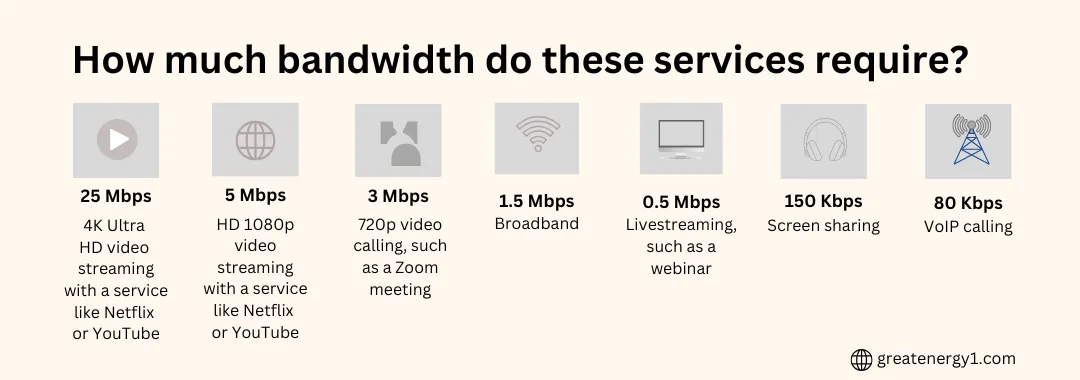
Since multiple devices share the same internet connection, bandwidth gets divided among them. High-usage devices like TVs streaming 4K video consume much more bandwidth than a simple webinar. While “speed” and “bandwidth” aren’t the same, having more bandwidth helps keep things running smoothly when multiple devices are connected.
Here’s a look at how much bandwidth different activities typically use:
Contact Us
Schedule a time to speak with one of our energy experts
Uses Of Bandwidth
1. Managing Network Traffic:
2. Bandwidth Throttling:
3. Improved Data Transfer:
4. System Bandwidth in Communications:
How To Measure Bandwidth
Considerations for Calculating Bandwidth
Wi-Fi vs. Mobile Bandwidth: What’s the Difference?
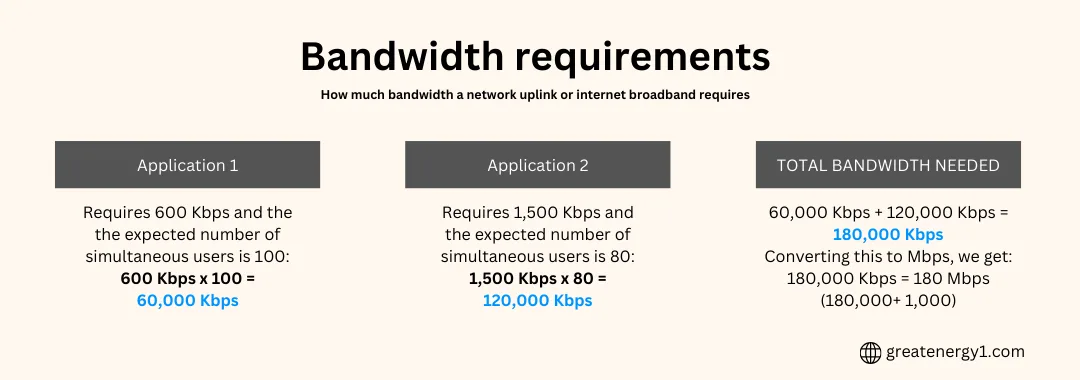
How to Calculate Bandwidth Requirements
- Identify the applications in use.
- Determine the bandwidth required for each application.
- Multiply each application’s bandwidth requirement by the number of simultaneous users.
- Add up all the application bandwidth requirements.
Common Energy Bandwidth Percentages
Energy suppliers offer different bandwidth allowances depending on the type of contract and the level of flexibility a business needs. The wider the bandwidth range, the more flexibility you have to increase or decrease your energy usage without triggering additional charges. However, greater flexibility usually comes with a slightly higher fixed energy rate because the supplier assumes more financial risk.
The table below outlines some of the most common energy bandwidth clauses used in commercial electricity and natural gas contracts.
Contract Bandwidth | What It Means | Best For |
80%-120% | Customers can use between 80% and 120% of their contracted energy volume without incurring bandwidth charges. | Businesses with seasonal or fluctuating energy consumption. |
90%–110% | A standard commercial bandwidth that allows a 10% variation above or below the contracted volume. | Businesses with relatively stable but slightly variable energy usage. |
95%–105% | A narrow usage tolerance that requires energy consumption to stay close to the contracted amount. | Companies with highly predictable energy demand. |
100% Swing (Unlimited Bandwidth) | Customers can use significantly more or less energy than forecast without bandwidth penalties, subject to contract terms. | Businesses with unpredictable operations or rapidly changing energy requirements. |
Lower Flexibility vs. Higher Flexibility
Choosing the right bandwidth depends on how predictable your energy consumption is.
- Lower Flexibility (95%-105%) offers tighter usage limits and is generally suited to businesses with consistent energy demand. Because suppliers face less risk, these contracts often come with more competitive energy rates.
- Higher Flexibility (80%-120% or 100% Swing) allows businesses to adjust their energy consumption without worrying about exceeding narrow usage limits. This is particularly useful for organisations affected by seasonal demand, production changes, or business growth.
How Bandwidth Affects Energy Pricing
Bandwidth is one of the factors that influences the price of a fixed-rate energy contract. Suppliers purchase energy based on your estimated consumption, so the amount of flexibility they provide affects their level of financial risk. Narrow bandwidth clauses generally offer lower energy prices because your expected usage is easier to forecast.
Wider bandwidth clauses typically result in slightly higher contract rates, as suppliers must account for larger variations in energy demand. 100% swing contracts usually carry the highest premium because they provide maximum flexibility and transfer most of the usage risk to the supplier.
When selecting an energy contract, businesses should balance price against operational flexibility. Choosing a bandwidth clause that closely matches your historical energy usage can help minimize unexpected charges while ensuring your contract supports future business needs.
Need Help Choosing the Right Energy Bandwidth Clause?
Choosing the right energy bandwidth clause can make a significant difference to your energy costs and contract flexibility. At Great Energy 1, we help businesses compare commercial electricity and natural gas suppliers, review contract terms, and negotiate bandwidth clauses that align with their operational needs.
Whether you’re renewing an existing agreement or exploring new commercial energy procurement options, our team can help you secure a contract that balances competitive pricing with the flexibility your business requires.
Contact Great Energy 1 today to speak with one of our commercial energy specialists and find the right contract for your business.
Hear What People Are Saying About Us
Testimonial